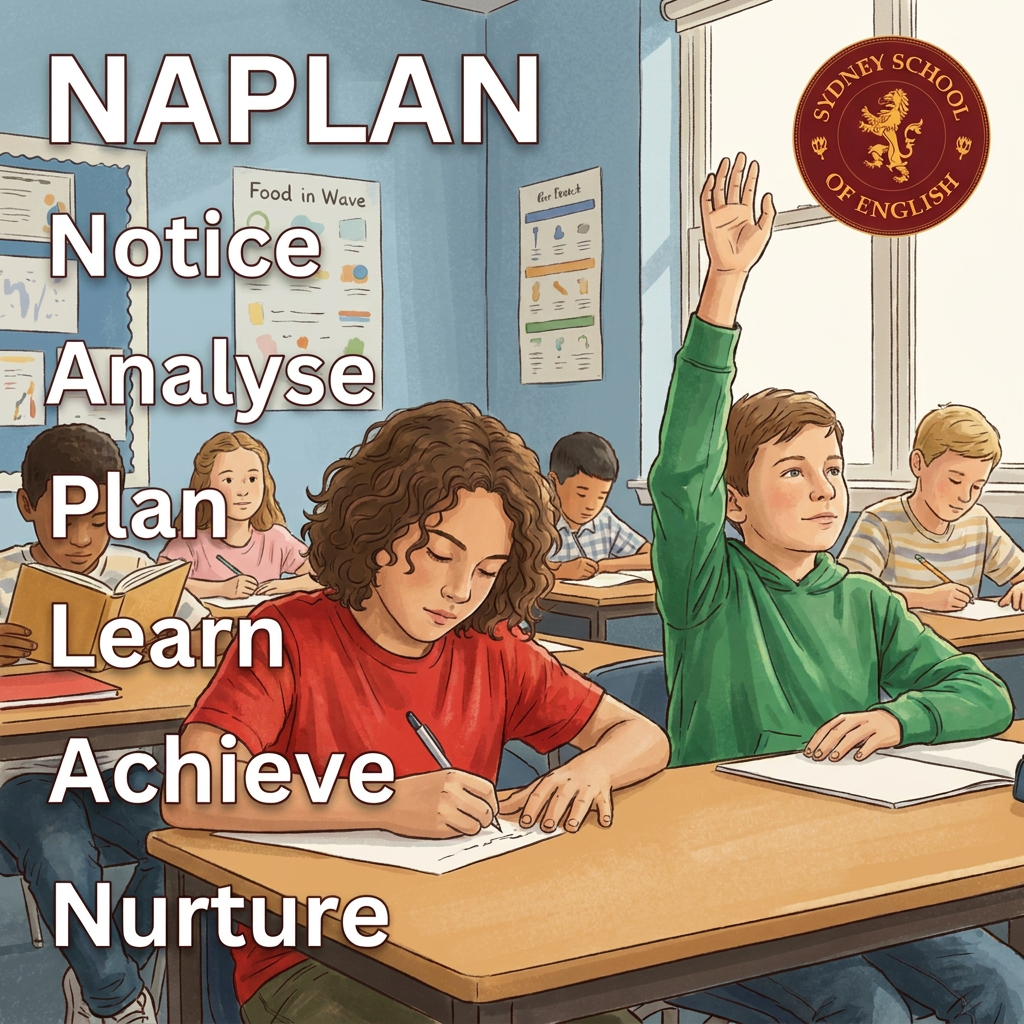
NAPLAN English Results Lower than Expected?
Many parents are surprised when their child’s NAPLAN report shows strong performance in numeracy, while the English component - reading (comprehension), writing or language conventions (grammar, punctuation and spelling) - sits noticeably below those results. If that sounds familiar, you’re not alone.
NAPLAN reports are designed to give a snapshot of where a student sits compared with national and state benchmarks, but the headline numbers can hide important detail and opportunities.
At the Sydney School of English (SSE), we see this pattern often — and we know how to turn it around.
Understanding the NAPLAN student report (briefly)
When parents receive the NAPLAN report it usually includes:
Scaled scores for each domain: reading (comprehension), writing, language conventions (grammar, punctuation and spelling) and numeracy, so you can see relative performance.
Comparisons to school, state and national averages or percentiles, highlighting where your child sits relative to peers.
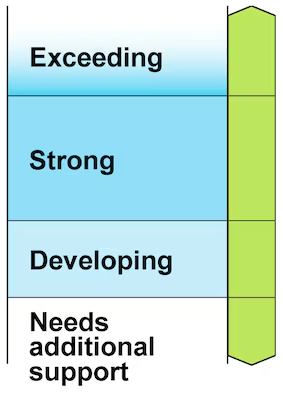
Proficiency bands that show whether your child is below, at, or above the expected level for their year:
Needs additional support
Student requires extra targeted academic intervention.
Developing
Student is working towards the expected standard and displays fundamental skills.
Strong
Student demonstrates good literacy and numeracy skills meeting the expected standard (average).
Exceeding
Student demonstrates expectations well beyond the target standard.
These elements are useful, but they don’t explain the “why” behind a lower English result or give a tailored roadmap for improvement. That’s where Sydney School of English makes a real difference.
Why English results sometimes lag
There are many reasons why a student can do well across other subjects yet struggle in English:
Maths can reward procedural problem solving and memorised methods, while English - especially writing and
reading comprehension - requires nuanced vocabulary, inferencing, organisation and expressive clarity.
NAPLAN’s timed tasks and specific question styles are designed to trip up students who understand the material.
Many students can produce strong work in class but underperform in a single, timed external test because of anxiety, planning issues, or unclear exam-technique.
For students whose first language is not English, or where perhaps, English is not used regularly in the home, subtle language conventions and idioms tested by NAPLAN can be especially challenging.
How the Sydney School of English can improve your child’s NAPLAN English results
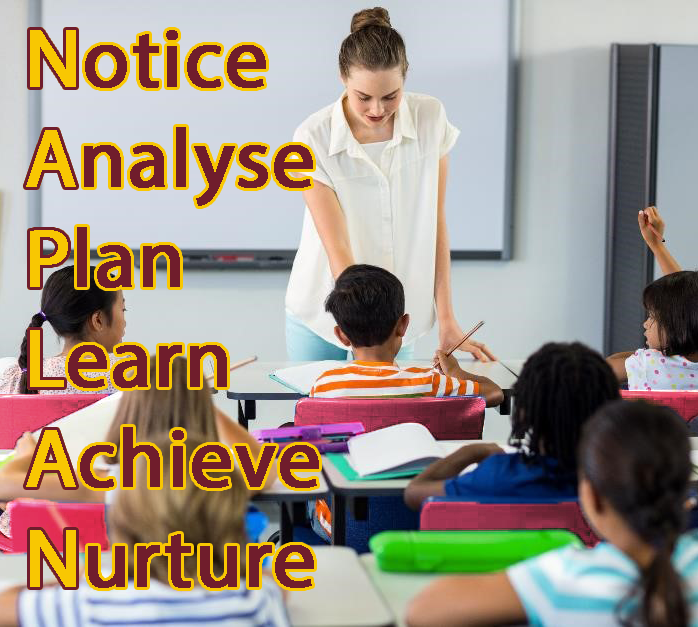
The Sydney School of English specialises in translating the data in NAPLAN results into rapid, measurable progress. Our approach is practical, evidence-based and proven:
Reading comprehension (literal vs inferential understanding),
Vocabulary depth, academic word knowledge, and using it in context,
Writing structure (planning, paragraphing, cohesion),
Sentence-level skills (grammar, punctuation, spelling),
Teaching is focused, explicit, efficient and effective.
Reading comprehension: explicit instruction by qualified teachers in skimming, scanning, inference, identifying main ideas and analysing tone and purpose.
Writing: planning templates, literary language techniques, sentence structures, paragraph linking, and text-type practice, such as narrative, persuasive, informative and all off the sub-genres.
Language conventions: short, weekly, high-impact sessions on grammar, punctuation and spelling patterns students actually need to master for all writing.
Academic level vocabulary in preparation for any writing milestone, such as: NAPLAN, the NSW Selective School Placement Test and Scholarship Tests.
This is not rote memorisation - we use context-rich methods (texts, word maps, spaced retrieval) so new words and structures transfer directly into reading comprehension and writing - and students are not just learning the order of letters that create a word they can never use - as they do not understand how to use it.
All students improve considerably once they adopt an effective, repeatable writing process and develop their own unique style.
The SSE provides termly progress reports aligned to the NSW Common Grade Scale so parents can see improvement in the development of practical skills.
Students of Sydney School of English show improvements in clarity and organisation of writing, more reliable inference-making in reading, and fewer mechanical errors in language conventions within just a few terms. For most students this translates into moving up a full proficiency band within a short period of time - a difference that’s noticeable in classroom confidence and assessment results, not just the NAPLAN report.
What parents should look for when choosing support
• Results orientated lessons
• Clear goals and measurable milestones tracked and reported.
• Teachers, like the SSE’s, who not only understand NAPLAN’s format and marking focus, but who mark NAPLAN Tests (and NSW Selective High School Placement Tests) on an ongoing basis as part of their NSW Dept. of Education duties.
• Proven techniques for writing, vocabulary, reading (comprehension), language conventions (grammar, punctuation and spelling) and test skills, professionally developed since 2003.
The Sydney School of English not only meets all these criteria, but it is also considered the benchmark in English tuition since 2003. We do not cut corners and instead, specialise in helping students whose English scores don’t match their other strengths.
What parents should avoid when choosing support
“One-size-fits-all” tutoring: your child is unique and deserves the opportunity to stand out from the crowd.
Mass online lecturing: where your child is unable to ask a question and receive an answer in real time, or perhaps they’re just a number in a class of up to 100 students.
Devices in the classroom: devices are distractions, and allowing children to work autonomously, using a device, means locking down many of the device’s abilities, like access to the Internet, Artificial Intelligence assistance (ChatGPT, Google Gemini, Perplexity Ai or Microsoft CoPilot) spellcheck, autocorrect, predictive text and games – all of which are proven to distract, slow, and even prevent cognitive learning and memory retention. In addition, students see educational tasks as obstacles, keeping them away from using the device for entertainment, and so, they rush through tasks without taking on its learning purpose.
Lessons taught by “tutors” or “educators”, who are unable to answer questions in real time, without Googling the answer themselves – our qualified teachers are experienced, NESA accredited and further trained by our Principal, Jill, to ensure consistency in the delivery of our programs utilising the expert methods only the SSE provides. We do not hire students with high ATARs to teach our students.
Worksheet-based lessons – worksheets do not teach – teachers teach. A worksheet is like cutlery, i.e. a fork is a tool to help us eat, but it does not feed us; a worksheet is an aid, as is the whiteboard, as is the teacher’s body language, as is the teacher’s anecdotes, and everything else that makes a teacher, a teacher - and not a worksheet provider. It is used to practise or revise but not to replace teaching. A worksheet has no chance whatsoever of “teaching”. It is merely a piece of paper, an innate object, incapable of thinking, speaking, answering questions, amending, praising, changing, revising, organising, concept checking etc. Too many worksheets means less time teaching. The worksheet is not, cannot and never should be, the teacher - and any teacher (mostly tutors/educators) who can be replaced by a worksheet, deserves to be!
Next Steps
The good news is that targeted, evidence-based support produces fast, sustainable, long-term improvements.
A lower-than-expected NAPLAN English result doesn’t mean your child cannot improve - significantly - it means they need targeted instruction in English writing skills – the skills required for success in all subjects, and milestones of a school career.
The Sydney School of English has the specialist experience, teachers, and program structure and strategies to help your child close the gap and regain confidence.
The Specialist in Selective School and Scholarship Test Writing.
Real Teachers, Real Results!
Subscribe to our newsletter!
The latest news, articles, and resources, sent to your inbox. Don't worry, we won't spam you.
© 2026 Sydney School of English Pty. Limited. All rights reserved.